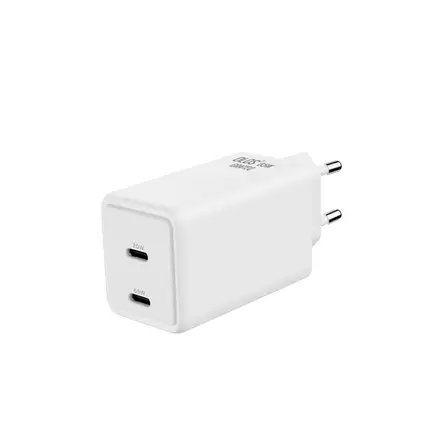
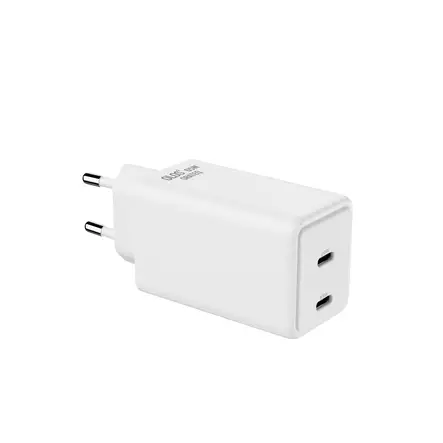
A charger has to match your phone's charging port and fast-charging standard. Most new phones have USB-C, and an iPhone fast-charges with a USB-C PD charger of at least 20 watts. Samsung's Super Fast Charging requires a charger with PPS support, so check for the PPS marking in the charger's details. A GaN charger is smaller than a conventional charger of the same power. The wall chargers in our range are 12–140 watts, and with the most powerful ones you can also charge a laptop that supports USB-C charging.
There are cables with USB-C, Lightning and micro-USB connectors, and power banks with a capacity of 5,000–72,000 mAh give you extra power. For wireless charging there are Qi pads and stands. Brands include Wave, Xtorm, Apple, Samsung, Deltaco and Grateq.


A 20–45 watt charger is usually enough for a phone. A laptop usually needs more power, so if you want one charger for all your devices, choose a 65–140 watt USB-C PD charger and check how much power your laptop needs. In a multi-port charger the power is shared between the ports when you charge several devices at once. GaN chargers use gallium nitride, which makes the charger smaller than a conventional one of the same power.
With a cable, the connectors and power are what matter. For Lightning cables it is worth choosing an MFi-certified one, which Apple has approved for the iPhone. USB-C cables are available for 100 and 240 watts, and a longer cable helps when the socket is far from your bed or sofa. The cables in our range are from 6 centimetres to 3 metres long.
A power bank charges your phone on trips, while travelling and during a power cut. A 5,000–10,000 mAh model fits in a pocket. With a 20,000 mAh or larger model you can also charge a tablet or laptop if the power bank's USB-C PD output provides enough power for the device. A MagSafe-compatible power bank attaches magnetically to the back of an iPhone that supports MagSafe. For the car there are USB-C car chargers and Qi holders, and for the cottage and outdoors there are solar chargers.
Our range includes chargers and cables from Wave, Apple, Xtorm, Deltaco, Samsung, Vivanco and Honor as well as cables from Grateq and Rolling Square. To protect your phone, see cases and screen protectors.
A 20–45 watt USB-C charger is enough for most phones, as long as it supports the phone's fast-charging standard: USB-C PD for the iPhone and PPS for Samsung's Super Fast Charging, found for example in Samsung's 25 and 45 watt chargers. A larger charger does not harm the phone, because the phone only draws the power it can take. A larger charger is useful if you also charge a tablet or laptop with it.
USB Power Delivery (PD) is the fast-charging standard for USB-C, in which the charger and the device agree on a suitable voltage and power. PPS (Programmable Power Supply) is an extension of PD in which the voltage is adjusted in small steps during charging. Samsung's Super Fast Charging requires PPS support, and the iPhone uses PD charging. Check which standards the charger supports in its product details.
Usually, yes. A 10,000 mAh power bank charges a typical smartphone fully about 1–2 times, depending on the size of the phone's battery. Not all of the rated capacity reaches the phone, because some energy is lost in voltage conversion. If you charge several devices or spend several days without electricity, choose a model of 20,000 mAh or more.
Yes, but only in your hand luggage, never in checked baggage. Under the rules tightened in 2026, each passenger may bring at most two power banks, and each may have a capacity of at most 100 watt-hours. You may not charge devices from a power bank during the flight. You get the watt-hours by multiplying the capacity (mAh) by the battery voltage and dividing by a thousand: a 20,000 mAh power bank at 3.7 volts is about 74 Wh. Check your airline's own rules before you travel.
In our stores, you can reach our knowledgeable staff on-site. Our online store customer service is also available to help you via chat, phone, and email. You can find our Euronics stores in the following locations: